Water is an essential part of many industrial and commercial operations. It may be used for production, equipment cooling, boiler feed, cleaning, process applications, sanitation, or general utility requirements.
However, raw water does not always have the quality required by industrial equipment and processes.
Depending on the source, water may contain suspended solids, hardness minerals, chlorine, dissolved salts, iron, organic matter, microorganisms, and other impurities. If these are not properly managed, they can contribute to scaling, corrosion, fouling, poor equipment performance, inconsistent product quality, and higher maintenance costs.
An appropriately designed industrial water treatment system in the Philippines helps condition raw water according to the actual requirements of the facility.
Rather than relying on one treatment technology for every application, an effective system combines the right equipment based on the raw water condition, required flow rate, operating schedule, and intended use of the treated water.
What Is an Industrial Water Treatment System?
An industrial water treatment system is a combination of equipment and treatment processes used to improve raw water before it enters a facility’s process or utility system.
The treatment requirement may be simple or complex.
Some applications may only require removal of suspended particles. Others may require hardness reduction, chlorine removal, iron treatment, or significant reduction of dissolved minerals using reverse osmosis.
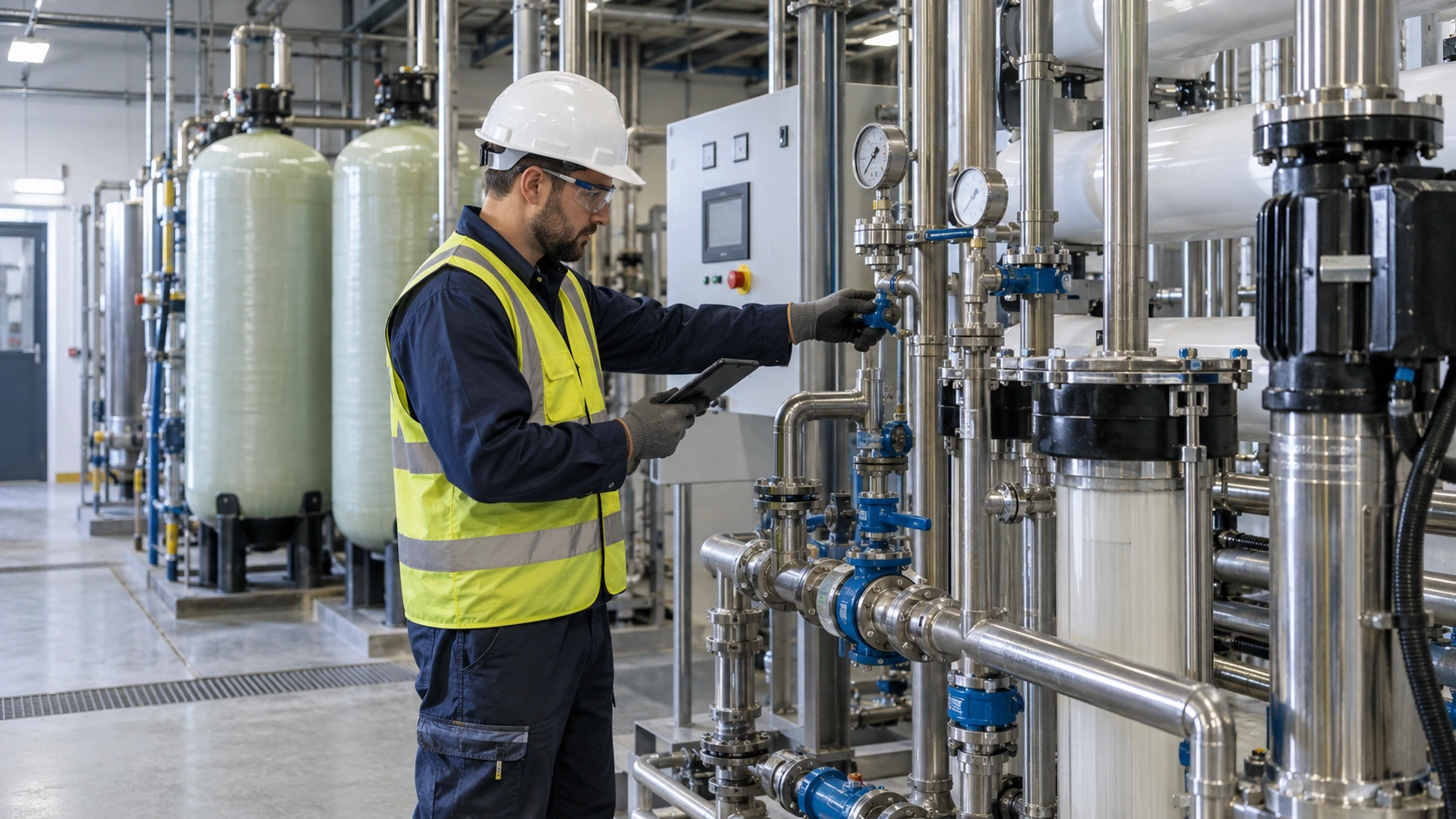
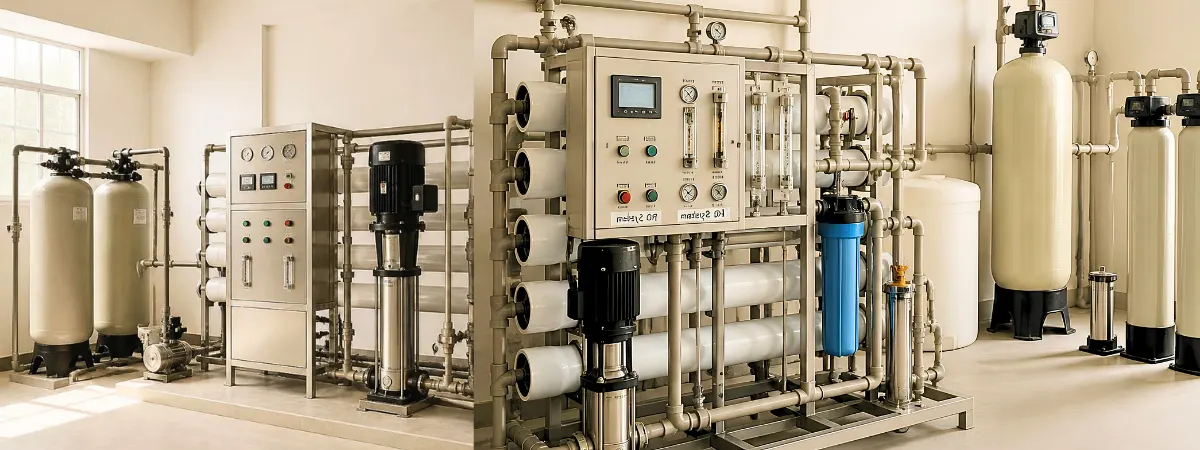
A complete system may include:
- Raw water storage
- Feed and transfer pumps
- Multimedia filtration
- Activated carbon filtration
- Water softening
- Cartridge filtration
- Reverse osmosis
- Chemical dosing
- Product water storage
- Pumps and piping
- Electrical controls and instrumentation
The actual arrangement depends on the water analysis and the quality required by the operation.
Why Industrial Water Treatment Is Important
Water quality directly affects many types of mechanical and process equipment.
Hard water, for example, can leave mineral deposits inside pipelines, heat exchangers, boilers, cooling systems, and other equipment. Suspended particles can accumulate in filters, valves, membranes, and piping. Chlorine and certain dissolved substances may also affect equipment depending on the materials and processes involved.
Proper water treatment can help a facility achieve several operational objectives.
Protect Equipment
Reducing unwanted minerals, solids, and contaminants can help limit deposits and fouling inside equipment and piping.
Improve System Reliability
Consistent incoming water quality allows downstream equipment to operate under more predictable conditions.
Reduce Maintenance Requirements
Preventing excessive scale, sediment, and fouling may reduce the frequency of cleaning and corrective maintenance.
Support Process Requirements
Manufacturing and industrial processes often require water with specific characteristics. Treatment allows raw water to be conditioned according to those requirements.
Improve Equipment Service Life
When equipment operates with water that meets its intended design conditions, unnecessary stress caused by poor water quality can be minimized.
Common Water Quality Problems in Industrial Facilities
Before selecting treatment equipment, the first step should normally be to understand the condition of the raw water.
Water may come from a deep well, municipal supply, surface source, storage facility, or a combination of sources.
Common parameters that may influence treatment design include:
- Turbidity
- Total suspended solids
- Hardness
- Iron
- Manganese
- Chlorine
- pH
- Total dissolved solids
- Conductivity
- Alkalinity
- Silica
- Microbiological condition
The importance of each parameter depends on how the water will be used.
For this reason, Kanotech recommends evaluating available laboratory water analysis together with the operating requirements of the facility before finalizing equipment selection.
Main Components of an Industrial Water Treatment System
Different treatment stages perform different functions. A well-designed system uses only the processes necessary to achieve the required water quality.
Multimedia Filtration
A multimedia filter is commonly used as an initial filtration stage.
It contains layers of filtration media designed to capture suspended particles and reduce turbidity as water passes through the vessel.
Multimedia filtration can help remove:
- Sand
- Sediment
- Rust particles
- Suspended solids
- Other particulate matter
It is often installed before more sensitive equipment to reduce the solids load entering the downstream treatment stages.
The filter normally requires periodic backwashing to remove accumulated material from the media bed.
Activated Carbon Filtration
Activated carbon filtration is commonly used when the treatment objective includes removal or reduction of chlorine, odor, color, and certain organic substances.
It is particularly important when chlorine-sensitive treatment equipment is installed downstream.
In a reverse osmosis system, for example, proper pretreatment must be considered because some membrane materials can be affected by oxidizing chemicals.
Activated carbon filters also require proper sizing, maintenance, and periodic replacement or servicing of the filter media.
Water Softening
A water softener is used primarily to reduce hardness caused by calcium and magnesium.
Hardness is one of the most common causes of scale formation in industrial water systems.
A typical softener uses ion-exchange resin. As hard water passes through the resin bed, hardness minerals are exchanged with sodium ions.
When the resin reaches its working capacity, it must undergo regeneration using a brine solution.
Water softeners may be used for applications such as:
- Boiler feed pretreatment
- Process water
- Laundry operations
- Equipment protection
- Reverse osmosis pretreatment
- General industrial water conditioning
The correct softener capacity should be determined from the water hardness, required flow, daily consumption, and desired regeneration frequency.
Reverse Osmosis
Reverse osmosis, commonly known as RO, is used when a facility requires substantial reduction of dissolved salts and other dissolved substances.
An RO system uses pressure to move water through a semi-permeable membrane.
A portion of the incoming water passes through the membrane as treated or product water, while a separate stream carries concentrated dissolved substances away from the membrane.
Industrial RO systems may be used for:
- Process water
- Boiler feed preparation
- Manufacturing applications
- Food and beverage applications
- Equipment requiring lower dissolved mineral content
- Other industrial processes requiring controlled water quality
RO performance depends heavily on proper pretreatment.
Installing an RO system without considering hardness, turbidity, chlorine, iron, operating pressure, temperature, recovery rate, and membrane loading can result in frequent cleaning, membrane fouling, poor production, or shortened membrane life.
Cartridge Filtration
Cartridge filters are often installed before an RO membrane or other sensitive equipment.
Their purpose is to capture finer particles that may remain after the main filtration stages.
Cartridge micron rating and size should be selected based on equipment requirements and expected water quality.
These filters must be inspected and replaced when pressure differential or operating conditions indicate that they have accumulated excessive solids.
How to Determine the Right Water Treatment System
Choosing water treatment equipment based only on vessel size or equipment price can lead to an underperforming system.
Several engineering factors should be reviewed first.
1. Raw Water Analysis
The treatment process should begin with knowing what is present in the water.
Without sufficient water-quality information, equipment selection becomes largely guesswork.
2. Required Water Quality
The desired treated-water specification should be established according to its final application.
Water used for washing does not necessarily require the same treatment as water used for a boiler, manufacturing process, cooling system, or sensitive production equipment.
3. Daily Water Demand
The system must be capable of producing enough water for the facility.
Daily demand is normally expressed in cubic meters per day, but system design must also consider actual operating hours.
A facility requiring 100 cubic meters per day but operating the treatment plant for only ten hours will require a different instantaneous flow capacity from a facility running the system continuously.
4. Peak Flow Requirement
Average daily consumption alone is not enough.
The system must also accommodate periods when water demand increases significantly.
5. Available Space
Filters, pumps, chemical tanks, RO skids, product-water tanks, electrical panels, maintenance access, and piping all require sufficient working space.
A good layout should allow operators to inspect and maintain equipment without unnecessary obstruction.
6. Utilities and Drainage
Water treatment systems may require electricity, raw water supply, drainage for backwash and regeneration, chemical handling areas, and adequate access for servicing.
These requirements should be incorporated into the facility design.
Why Proper System Design Matters
A larger treatment system is not automatically a better treatment system.
Oversized equipment can increase capital cost and occupy unnecessary space, while undersized equipment may struggle to meet flow requirements and can require more frequent servicing.
The treatment sequence also matters.
For example, placing equipment in the wrong order may expose sensitive downstream components to contaminants that should have been removed earlier.
A properly engineered system considers the entire treatment process—from raw water entry to final distribution.
This includes:
Raw Water Source → Pretreatment → Filtration → Conditioning → RO or Final Treatment → Product Water Storage → Distribution
Each stage should support the performance of the next.
Water Treatment System Operation and Maintenance
Even a correctly designed system requires regular monitoring.
Operators should routinely check items such as:
- Pressure
- Flow rate
- Water quality
- Pump operation
- Filter condition
- Softener regeneration
- Brine level
- Cartridge filters
- RO product flow
- RO reject flow
- Conductivity
- Chemical dosing
- Valves and piping
- Electrical controls
Operating records are also valuable because changes in pressure, flow, or water quality can provide early indications that equipment requires servicing.
Preventive maintenance is generally more manageable than waiting until a water treatment system experiences a major operational problem.
Industrial Water Treatment Solutions from Kanotech
Kanotech Industrial Engineering Services provides water treatment solutions for industrial and commercial applications.
Our scope may include system assessment, engineering design, equipment supply, installation, piping, electrical works, testing, commissioning, rehabilitation, maintenance, and technical support depending on project requirements.
Kanotech works with treatment equipment such as:
- Multimedia filtration systems
- Activated carbon filters
- Water softeners
- Reverse osmosis systems
- Pumps
- Pressure vessels
- Storage tanks
- Chemical dosing systems
- Valves and piping
- Electrical and control components
Our approach begins by understanding the facility’s water source, water quality, required capacity, intended application, available space, and operating conditions before recommending a treatment configuration.
The objective is not simply to install equipment. The goal is to provide a water treatment system that is practical to operate, maintainable, and appropriate for the actual needs of the facility.
Need an Industrial Water Treatment System?
Every facility has different water requirements.
A treatment system suitable for one plant may not be appropriate for another, even when their daily water consumption appears similar.
If your facility is planning a new water treatment system, upgrading an existing installation, or experiencing problems with filtration, hardness, RO performance, pumps, or water quality, Kanotech can assist in evaluating the system requirements and identifying an appropriate treatment approach.